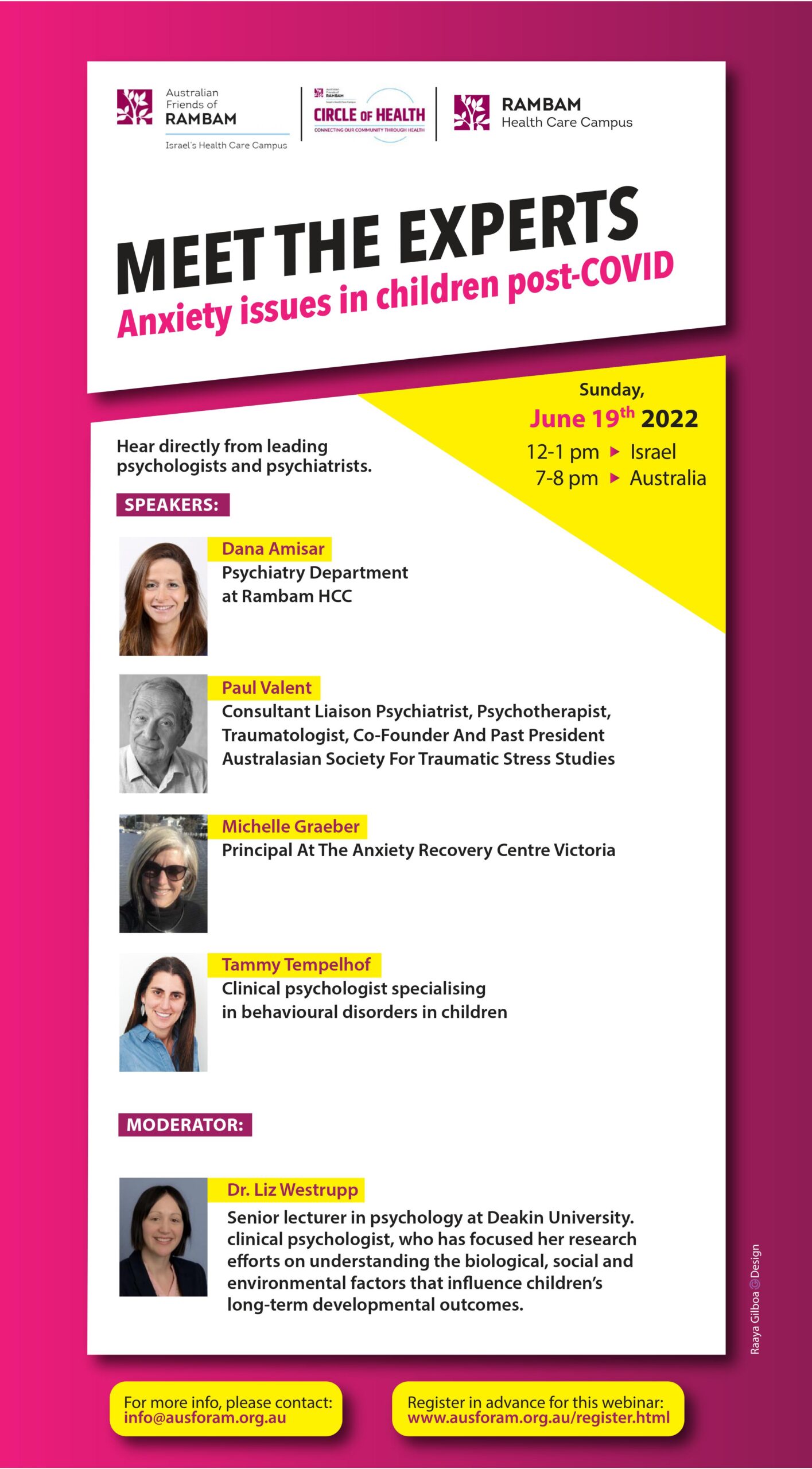
Meet The Experts
Our Helpline OCD & Anxiety HelpLine 03 9830 0533 or 1300 ANXIETY ● 1300 269 438
Hear directly from leading psychologists and psychiatrists.
Dates:
Sunday, June 19th 2022
12-1 pm Israel
7-8 pm Australia
Venue: Webinar
Register in advance for this webinar:
www.ausforam.org.au/register.html
For more info, please contact:
info@ausforam.org.au
• Reflect on how your attitudes and beliefs about suicide affect your intervention role
• Discuss suicide with a person thinking about suicide in a clear and direct manner
• Build a collaborative approach to intervention focused on safe outcomes
• Review immediate suicide risk and develop appropriate safeplans
• Recognize that suicide prevention is broader than suicide first aid and includes life promotion and self care for caregivers
ASIST is run by registered LivingWorks trainers and uses internationally standardized learning materials.
NOTE: It is a requirement to attend both full days
ARCVic Office – 9830 0566 or Helpline – 9830 0533 / 1300 269 438
Email: admin@arcvic.connexionpoint.com.au
web: www.arcvic.org.au
Anxiety disorders can seriously affect a student’s ability to learn and take in new information. This is because stress has a negative impact on our ability to concentrate, make decisions and solve problems.
To go some way to combat this, last year we teamed up with Bayside Glen Eira Kingston Local Learning & Employment Network (BGKLLEN) to create the Managing Stress and Anxiety Teacher Resource Kit.
This free kit can be downloaded and used by teachers to both create a classroom space that is anxiety-aware and discover methods to implement within the classroom when students become elevated.
To download your free copy, visit the BGKLLEN website
Researchers at Swinburne University of Technology have developed a free group program to assist people who care for someone who experiences Hoarding Disorder. The program aims to provide information about the causes and treatment of Hoarding and to develop strategies to assist you with living with Hoarding.
The program has been developed for people (including spouses, parents, siblings, children, partners or carers) who live or support someone experiencing Hoarding. There is no need for the person you care about to be formally diagnosed with Hoarding Disorder or to be in treatment. If you are over 18 years of age, and the person experiencing Hoarding is over 18 and you would like further information please contact The Swinburne Psychology Clinic on 9214 5528 or at psychprojects@swin.edu.au
This workshop is focused on increasing understanding and coping skills around traumatic stress reactions whilst keeping Post Traumatic Growth in mind. It consists of 6 x 1.5 hour sessions that provide information for participants about PTSD and how it effects the brain, individual treatment options when working with a therapist, identifying values and learning new skills in mindfulness and grounding techniques with the purpose of moving towards a valued and meaningful life.
Facilitated by George Kontis MAPS
George is a registered psychologist with a Masters Degree in Clinical Psychology. He has extensive previous experience facilitating support groups and working with a range of psychological issues, including providing support to individuals experiencing post-traumatic stress. He uses evidence-based approaches including cognitive behavioural therapy, acceptance and commitment therapy, motivational interviewing, mindfulness and compassion focussed therapy.
Many people will experience a traumatic event in their lifetime which can understandably be highly stressful and emotionally challenging. However given the right support and circumstances, most people recover in the weeks following it. Some people may react in a more severe and enduring way, resulting in a diagnosis of Post Traumatic Stress Disorder (PTSD). Recent Australian studies have reported the lifetime prevalence rates of PTSD in the community at 7.7%. Despite the pain and distress, many people also report great psychological and spiritual growth and other positive outcomes from the recovery journey. These psychological changes, known as Post Traumatic Growth can include the perception of improved interpersonal relationships, enhanced personal strength, new possibilities, spiritual growth and an increased appreciation of life (Tedeschi & Calhoun, 2004).
A brief telephone interview will be undertaken with interested participants. Places fill quickly so please call or e-mail to register your interest and to undertake a phone interview.
Dates: Wednesdays evenings 6.30-8.00pm – March 7th, 14th, 21st & 28th and April 4th & 11th
Venue:The Compassionate Friends – Victoria Inc. 229 Canterbury Road, Canterbury (Car parking at rear)
Fee: $189.90 for the program (Medicare rebates may apply for part of the cost)
Fees are required to be paid up front in order to secure your spot in the program once allocated to a workshop.
For further information, please contact Susan Konstantas on (03) 9830 0566 or email: skonstantas@arcvic.connexionpoint.com.au
A discussion that aims to talk about the expectations of living in Australia when you come from an Australian Asian and/or Indian background:
Would you like to participate in a unique opportunity to share your story of recovery?
My experiencing as a support group facilitator has been extremely
rewarding. I can see the benefits the groups provide our participants when they
return each session with things to share, and many say that they are just
grateful to have a safe space to connect with people going through similar
things. Some participants have also expressed that in Victoria they cannot
access support groups similar to those that ARCVic provides (e.g. for body
dysmorphia), so they are grateful that ARCVic allows them to share on these
matters and feel less alone. Nicola